Artificial Intelligence: Does it Understand Truth or Emulates it?
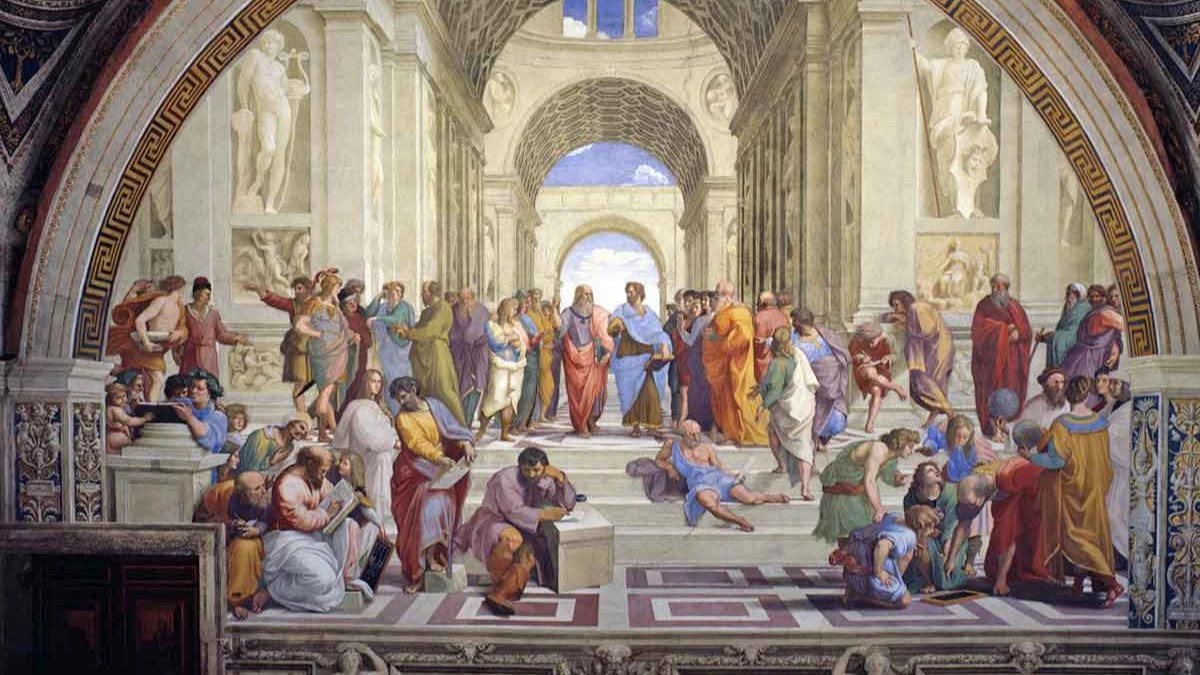 The School of Athens by Raphael, c. 1509-11. Source: Vatican Museums, Vatican City.
This essay was originally intended to be my essay submission for UTC1801 in NUS. However, due to its thought provoking nature, I found much meaning in this write up and decided to share it on my page as well. The painting seen above is Raphael's School of Athens, which dipicts a gathering of all ancient figures in the world of Philosophy, such as Plato, Aristotle and Socrates.
Introduction
We live in an era where Artificial Intelligence, or AI is a fundamental part of our routines and systems, day to day. It has assisted us in the little areas such as planning for a vacation, to playing an integral role in critical infrastructure such as financial networks and healthcare systems. Personally, I have friends who have experienced chatting with an AI assistant for emotional support or advice. It almost certainly seems as if it’s becoming... human.
This sparks a question: if an AI truly understands “Truth” or only simulates it to great accuracy in its responses and words. Or is truth meant to be calculated and derived from numbers and figures? This essay aims to share the philosophical perspective on Truth and how AI would approach it when it comes to fulfilling its taskings.
What is Truth?
Truth can be framed and perceived through two major theories in philosophy, the correspondence theory and coherence theory.
In correspondence theory, we can deem a statement or fact as true when it reflects our observations. For example, we know that the sky is blue because we observe it day to day. The correspondence theory was expressed by both Aristotle and Plato and continued to be formalised by Bertrand Russell and G.E. Moore in the 20th century. This simple theory became a core foundation for other theories of truth. Many theories that followed employed similar concepts of finding relations of a truth statement to reality, through concepts such as conformity, congruence and signification.
As for the coherence theory of Truth, it states that a statement of belief is true if it is also consistent with a larger set of beliefs. In the past, the coherence theory was commonly associated with idealism. It emerged mainly from German Idealist philosophy during the 18th and 19th centuries among philosophers like Baruch Spinoza, G.W.F. Hegel, and F.H. Bradley. Coherence can be seen from both the metaphysical and epistemological perspectives. From the metaphysical view, the truth of a belief is seen as its ability to integrate into reality’s large system of interconnected ideas and beliefs. Meanwhile, the epistemological view measures how truthful a belief or statement is based on our ability to justify it. In short, the metaphysical route focuses on defining what reality is in relation to truth and belief, whereas the epistemological route focuses on how we justify and comprehend truth.
I personally believe too that Truth is derived from a system of beliefs. For years, we compare our views with known facts discovered by others to make judgments or understand concepts new to us. For example, we grew up learning that World War II ended in 1945, which is a fact believed by educators, historians and historians in our day and age. And the facts they believe in originated from writers and significant figures from the past.
Does Artificial Intelligence understand Truth?
On a higher level of understanding, it appears that AI can believe in certain Truths and make fair judgments and reasonings when trying to help its user. The rise in popularity of reasoning models seems to prove its capability. Reasoning models are trained to break a problem into smaller steps or “reason traces”, by employing chain-of-thought reasoning on complex tasks like solving a large math question or producing code with robust logic.
AI also employs techniques to understand natural language, such as vectorisation, which converts the meaning of tokens, made of chunks of text or individual words, into numbers that a computer can make correlations and comparisons to in terms of their meaning.
However, looking back at how Truth is defined, from a philosophical perspective, Truth is built on experiences and beliefs. In correspondence, we experience something to know it is true, and in coherence, we know something is true from its ability to fit into a web of beliefs. Fundamentally, beliefs shape what we know is truly true.
As such, believing something is not the same as simply knowing it. From a book “Intuition Pumps and Other Tools for Thinking” by Daniel C. Dennett, Daniel illustrates the core building blocks of beliefs:
- An analogy is shared about a child who is asked what her father does for a living. The child would just reply that he is a doctor.
- The analogy goes on to illustrate that there is no certainty that she believes what she has said at that young age. In other words, just because she has said it, it does not mean she believes it.
- However, it is through her experiences growing up that she understands what a doctor does and relates that to her knowledge of her father.
- With this collection of knowledge and experiences, she will form her belief that her father is indeed a doctor.
In short, Daniel sees belief as something built on understanding, which is formed by real-world experiences. Truth is something built on beliefs, which cannot be derived from calculations alone.
Conclusion
I believe that AI does not understand Truth; rather, it has an ability to emulate it, to provide cutting-edge reasoning capabilities for us to form our own judgments on what is true or not. However, this does not minimise the value and purpose of AI in our lives. I strongly believe that as AI continues to advance and draw closer to mimicking human intelligence, it remains our role to define our own beliefs and Truths. While AI can support us with logic and reasoning, only we can offer the depth of human experiences and emotions.
References
(2013). In D. Dennett, Intuition Pumps And Other Tools for Thinking (p. 142). W. W. Norton & Company.
Bergmann, D. (n.d.). What is a reasoning model? Retrieved from IBM: https://www.ibm.com/think/topics/reasoning-model
David, Marian, Zalta, & Nodelman, U. (10 May, 2002). The Correspondence Theory of Truth. Retrieved from Stanford Encyclopedia of Philosophy: https://plato.stanford.edu/entries/truth- correspondence/
Redding, & Paul. (13 Feb, 1997). Georg Wilhelm Friedrich Hegel. Retrieved from Stanford Encyclopedia of Philosophy: https://plato.stanford.edu/entries/hegel/
Young, & James. (3 Sep, 1996). The Coherence Theory of Truth. Retrieved from Stanford Encyclopedia of Philosophy: https://plato.stanford.edu/entries/truth-coherence/